![[English Version] Policy Shifts Fast, Plastic Pollution Doesn’t](/_next/image?url=https%3A%2F%2Ffiles.jurno.id%2Fuploads%2Fdeduktif%2F1778561638_IlustrasiLaporanNinikYuniati.jpeg&w=3840&q=75 "[English Version] Policy Shifts Fast, Plastic Pollution Doesn’t")
[English Version] Policy Shifts Fast, Plastic Pollution Doesn’t

12 Mei, 2026
TL;DR
-
In Indonesia, plastic import ban sparked chaos, domestic waste management still remains ineffective.
-
Recycling industry struggled, government relaxed policies for industrial raw material needs.
-
Plastic burning persists, worsening pollution risks and long-term public health impacts.
Indonesia’s Ministry of Environment saw a leadership change on April 27, 2026. Hanif Faisol Nurofiq was reassigned as Deputy Coordinating Minister for Food Affairs, while his post was handed to Jumhur Hidayat, better known as a labor activist.
Every ministerial reshuffle raises questions about policy direction under President Prabowo Subianto’s administration. “New minister, new policy” is a familiar refrain.
At the beginning of his tenure, Hanif immediately floated the idea of banning plastic waste imports. According to him, domestic plastic waste had already piled up in landfills and remained largely unmanaged.
Data from Indonesia’s National Waste Management Information System (SIPSN) showed that national waste generation reached 56.6 million tons in 2023. About 18.71 percent—or 10.59 million tons—consisted of plastic waste. Yet only 12.1 percent, or 1.28 million tons, was properly managed.
“If domestic plastic waste is already abundant, why import it from abroad?” Hanif argued.
He also highlighted the risk of imports becoming a gateway for illegal waste trafficking and hazardous materials, recalling the scandal that surfaced in 2019. At the time, China’s National Sword Policy shut the door on plastic waste imports, prompting developed countries to redirect their waste to Southeast Asia, including Indonesia.
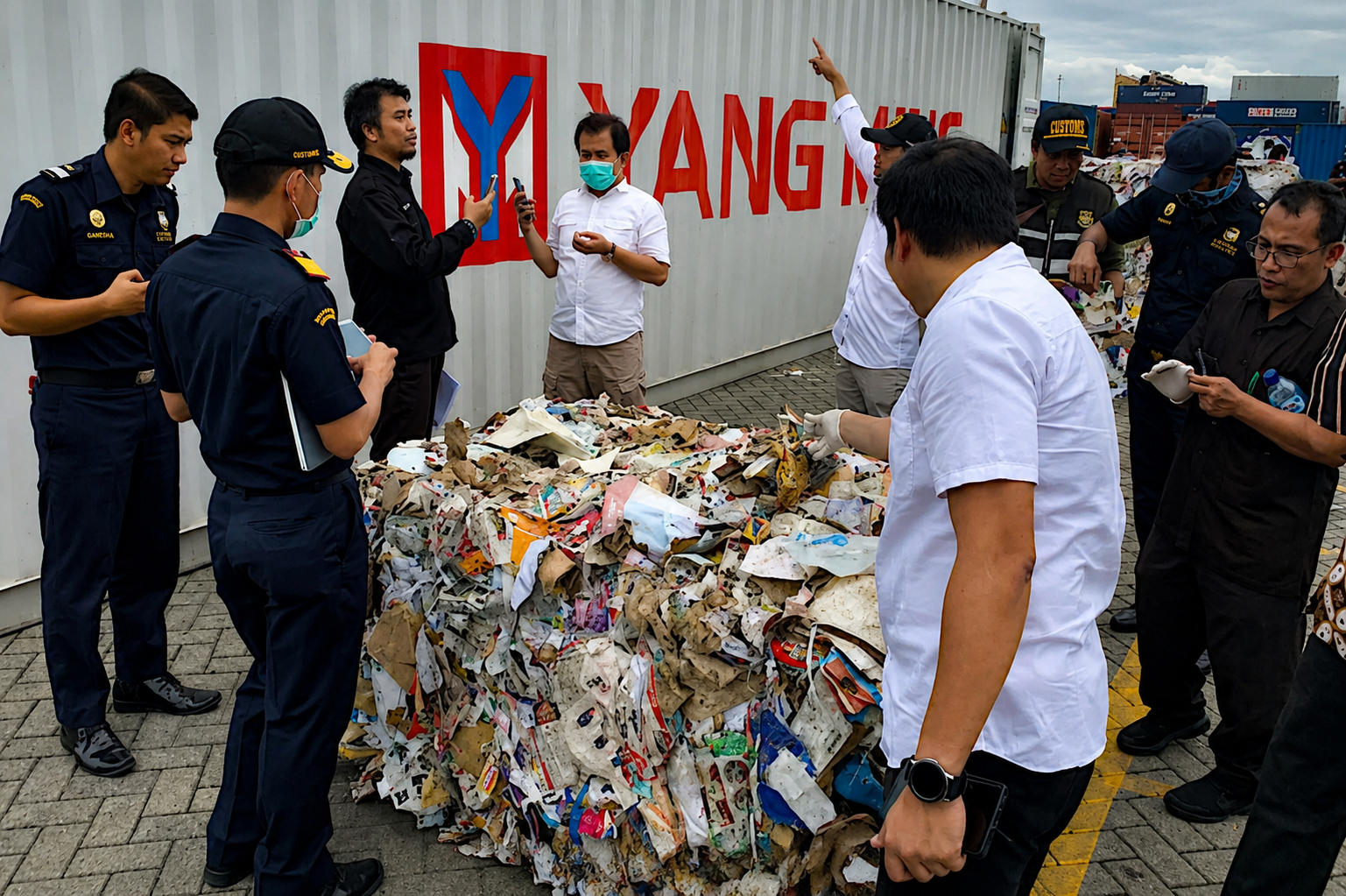
Indonesian customs officials examining seized paper waste imports contaminated with plastics and hazardous wastes. (Photo courtesy of ECOTON Indonesia / Prigi Arisandi, 2019)
Just two weeks after taking office, on November 5, 2024, Hanif sent letters to the Coordinating Minister for Economic Affairs, the Coordinating Minister for Food Affairs, and the Trade Minister, calling for a halt to plastic waste imports. He claimed to have secured President Prabowo’s approval during a visit to a food estate project in Merauke two days earlier.
He reiterated the proposal during his first meeting with House Commission XII on November 6, 2024, and again at the National Waste Management Coordination Meeting in December 2024. The import ban was announced to take effect on January 1, 2025, and became part of Hanif’s “100-day quick wins” program. Throughout the first half of his tenure, he repeatedly voiced commitments to ending plastic pollution.
Loud Policy
“It was like a firecracker — slammed to the ground, boom,” said Edy Supriyanto, Secretary General of the Indonesian Recycling Association (ADUPI), during an interview at ADUPI’s office in Tangerang, Banten, on April 7, 2026.
According to Edy, the policy created shockwaves without addressing the structural problems behind Indonesia’s waste system.
Plastic scrap imports abruptly stalled after the Environment Ministry stopped issuing import recommendations. Seventeen ADUPI member companies were reportedly pushed close to collapse due to raw material shortages. Between 50 and 70 percent of workers were furloughed.
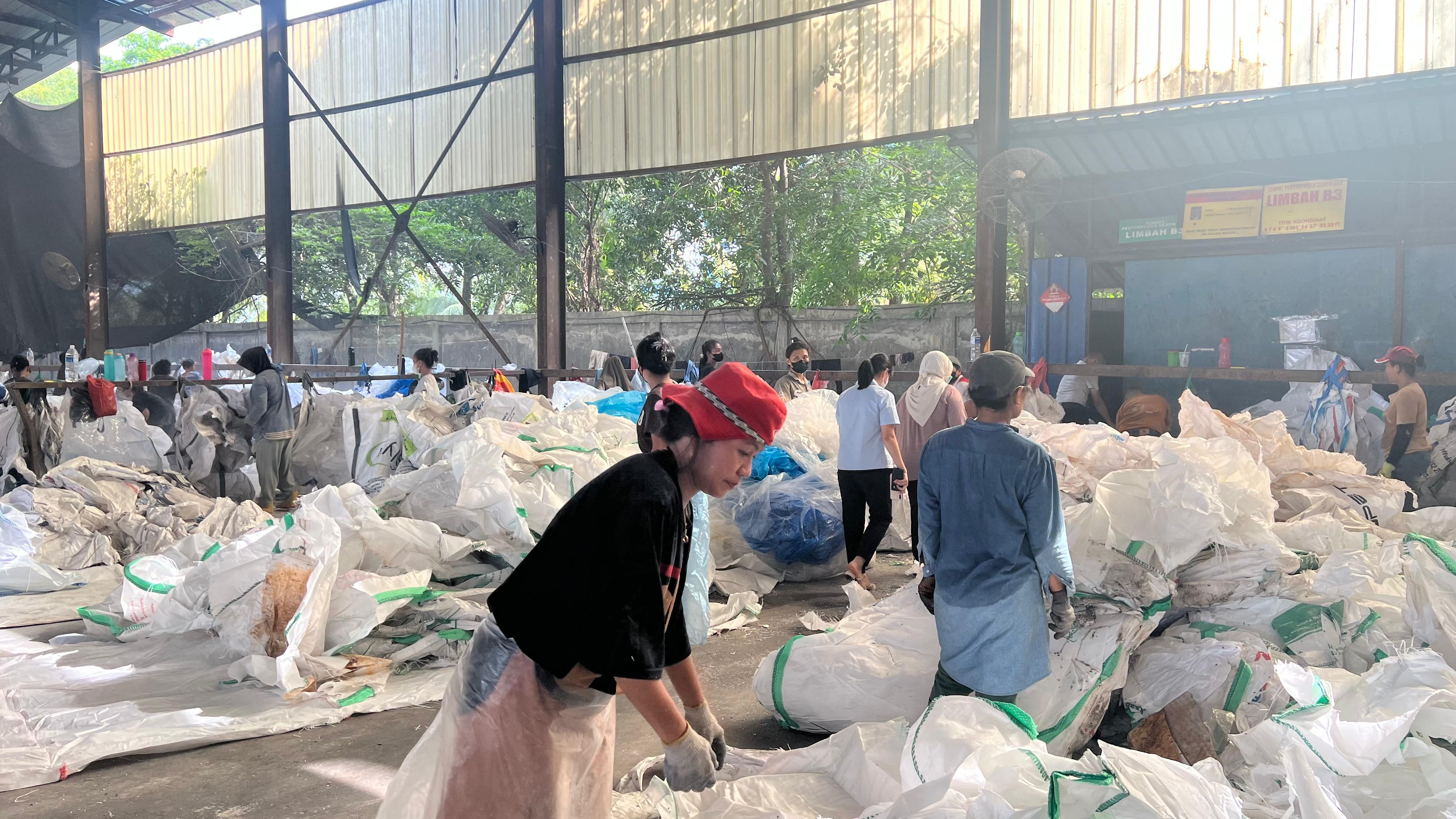
Workers at a recycling factory sort used sacks imported for recycling and re-export. Since the ban on plastic scrap imports took effect in 2025, around 50 to 70 percent of workers have been laid off due to a lack of raw materials. (Photo courtesy of ADUPI)
“This industry has invested heavily. Many companies rely on loans. If imports are suddenly banned, of course it hits hard,” he said.
Edy insisted the industry was not rejecting local raw materials. The problem, he said, was that domestic plastic waste is typically dirty and mixed with other waste streams, requiring a long processing chain from collection to sorting and treatment. That significantly increases production costs. Imported waste, by contrast, is considered cleaner and cheaper because it mostly comes from post-industrial waste rather than post-consumer trash.
A waste picker searches for recyclable plastics with resale value at the TPA Jalupang landfill in Karawang, highlighting the informal sector’s central role in Indonesia’s plastic recovery system.
ADUPI subsequently intensified lobbying efforts to soften the policy. The result: four recycling companies in Batam were once again allowed to import raw materials. The government argued that domestic supplies could not meet industrial demand in Batam, while shipping materials from Java would drive up production costs.
ADUPI is now hoping imports will be reopened more broadly and plans to seek an audience with Minister Jumhur.
Half-Hearted
The Environment Ministry’s relaxation of plastic scrap import restrictions drew criticism from Ecological Observation and Wetland Conservation (ECOTON), an environmental group based in Gresik, East Java.
ECOTON Education Division Manager M. Alaika Rahmatullah said he had doubted the government’s seriousness from the start because the policy was never translated into legally binding regulations.
ECOTON also criticized the government for overlooking paper scrap imports, despite the fact that they have repeatedly served as a channel for plastic waste entering Indonesia.
East Java has long been known as an imported waste hotspot due to its concentration of recycled paper industries. Imported paper materials are often contaminated with plastic, textiles, metals, and household waste. Residents living near factories separate out materials that still hold resale value, while plastic residues are used as fuel for tofu factories and lime kilns.
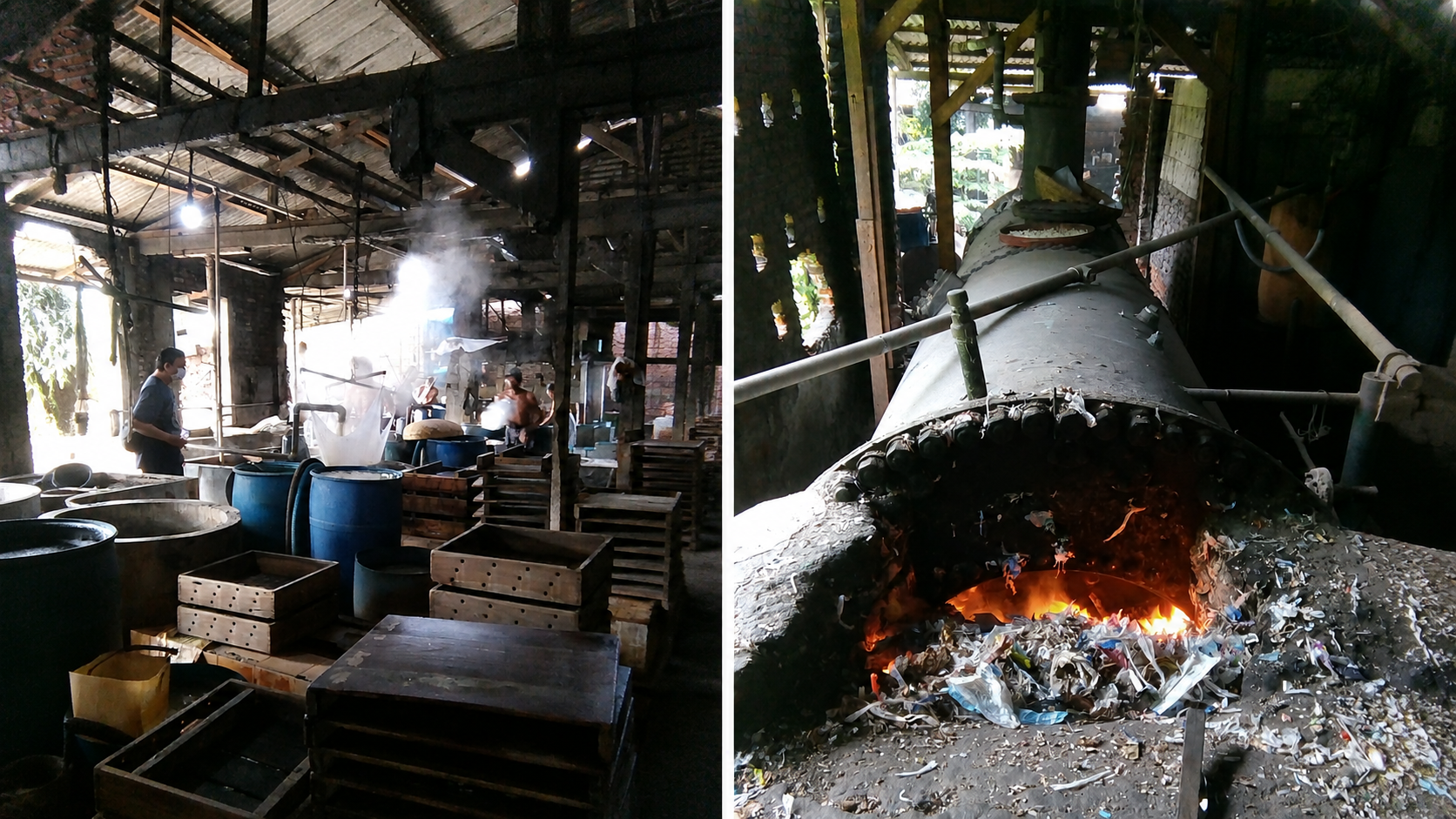
A tofu factory in Sidoarjo, East Java, uses plastic scrap as fuel for cooking. The practice has repeatedly drawn scrutiny over its high potential to pollute the environment and threaten public health. (Photo courtesy of Resky Novianto/KBR, February 2023).
Such practices have been documented across Gresik, Sidoarjo, Mojokerto, Malang, and Pasuruan. In Karawang, West Java, imported plastic residues are also burned in lime kilns in Pangkalan district.
ECOTON has repeatedly warned about the environmental and health impacts of plastic burning. Yet, according to the group, government attention tends to emerge only when the issue goes viral.
So what has actually changed since the plastic waste import ban supposedly took effect on January 1, 2025?
Based on ECOTON’s monitoring, paper mills in East Java continue importing recycled paper contaminated with plastic waste. The difference is that plastic scraps are no longer removed from the facilities, but stockpiled within factory grounds instead.
“Paper industries in East Java are now starting to build RDF (refuse-derived fuel) machines to process plastic residues from paper imports. But on the ground, large piles are still accumulating behind factories and remain unmanaged,” Alaika said in a written statement on May 4, 2026.
The situation remains alarming because the plastic residues still risk leaking into the environment whenever oversight weakens.
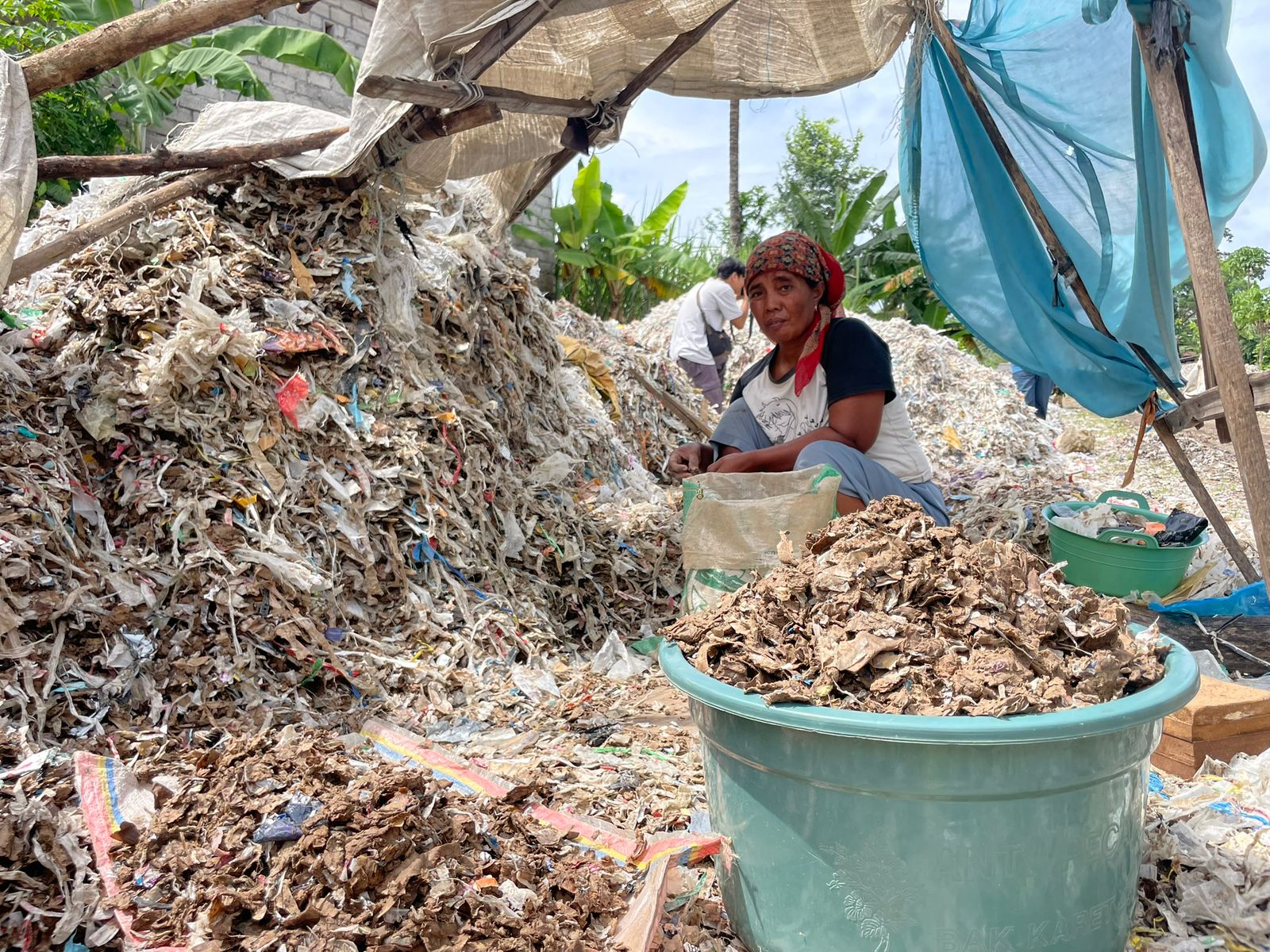
A resident sorts through piles of plastic scrap discarded from a paper mill in Pagak Village, Malang, East Java. The plastic waste was mixed with imported paper scrap used as raw material by the mill. The plastic residue is later burned in lime kilns. (Photo courtesy of ECOTON Indonesia).
The Impurity Loophole
Illegal plastic scrap imports remain possible due to regulations governing contamination — or “impurity” — levels, particularly under a joint decree signed in 2020 by the Environment Ministry, Trade Ministry, Industry Ministry, and the National Police.
The regulation allows contamination levels of up to 2 percent. According to ECOTON, the impurity threshold should be abolished altogether, while monitoring and transparency mechanisms are strengthened.\
“In reality, the limit is poorly controlled. Is it really 2 percent, or much higher? Weak oversight and the absence of strict verification from exporting countries worsen the situation, while unmanaged residues are often burned or dumped into the environment,” Alaika said.
ADUPI rejected the proposal. Edy argued that zero contamination is unrealistic. “If we’re talking about used materials, zero percent contamination is impossible. Unless you buy brand-new goods,” he said.
The Danger of Plastic Pollution
In April 2026, ECOTON again discovered piles of plastic residues near tofu factories in Tropodo, Sidoarjo. Several tofu producers were also found still using plastic as fuel, mixed with footwear factory waste, despite local government bans on the practice.
Indonesia’s Waste Management Law, enacted in 2008, also prohibits open waste burning.
ECOTON suspects that some imported plastic scraps are now being diverted to sausage casing factories and cracker factories for fuel.
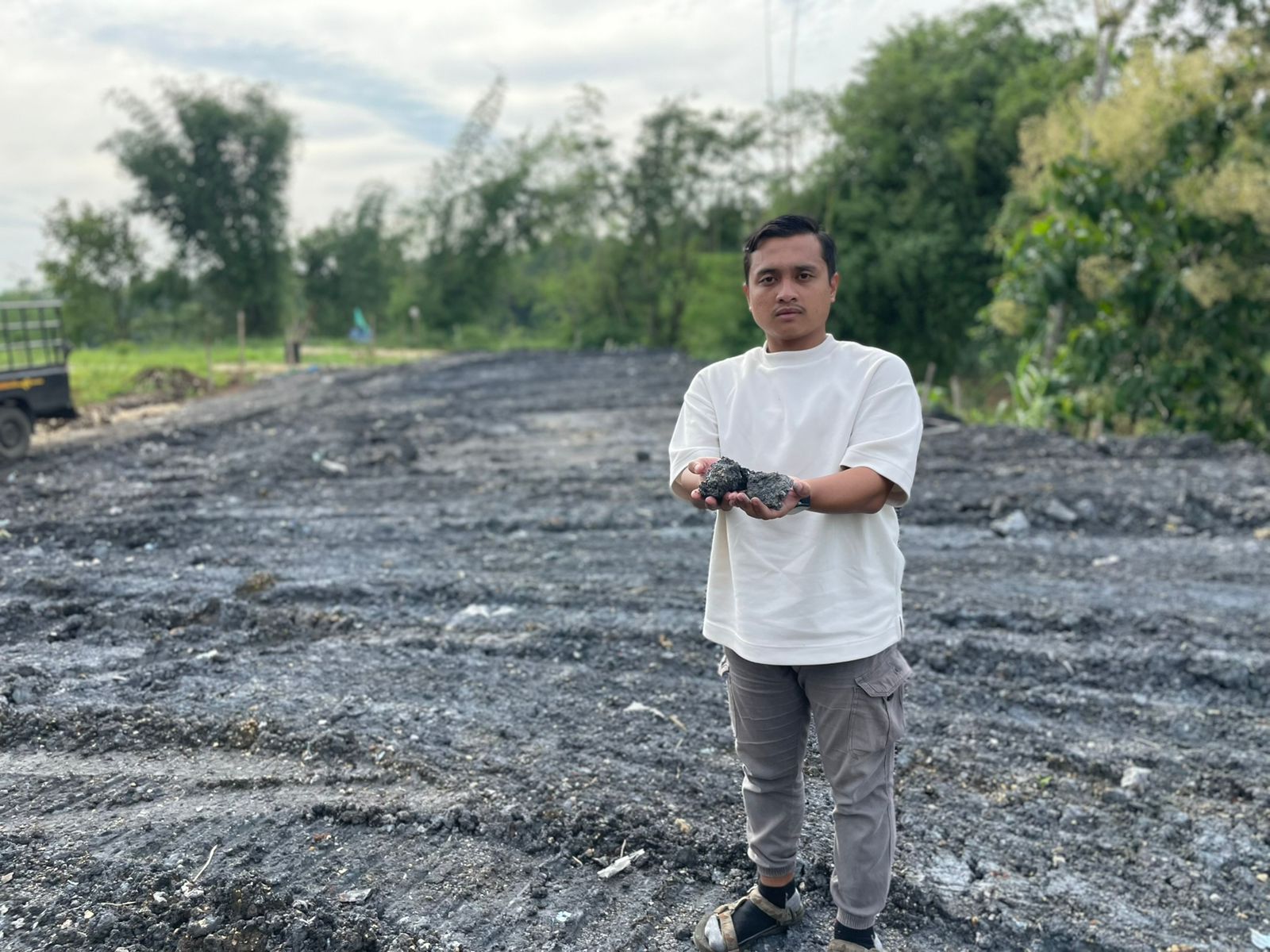
M. Alaika Rahmatullah, Education Division Manager at ECOTON, shows remnants of burned imported plastic scrap in Pagak Village, Malang, East Java. The ash residue was reportedly used as landfill material in the area. (Photo courtesy ECOTON Indonesia).
Meanwhile, in Pangkalan, Karawang, environmental activist Willy Firdaus said imported plastic scraps like those widely found in 2019 are no longer visible. However, local plastic waste continues to be burned in lime kilns.
Deduktif visited Pangkalan in 2017 and returned again in 2026. Little had changed. Lime-burning furnaces — locally known as lio — still lined the roadside. Thick black smoke continued billowing into the air every day.
Various kinds of waste — from plastic and rubber to textiles — are burned as fuel. The waste comes from Karawang, Bogor, Tangerang, and Jakarta. Talks of shutting down or relocating the kilns have surfaced repeatedly, but never materialized due to economic concerns.
Solihin, 70, a worker at one of the kilns in Tamansari village, Pangkalan, pleaded for the site to remain open because it was his family’s only source of income back in Brebes, Central Java. He said he would not object to relocation, as long as the business could continue operating.
“Please don’t shut it down. I have no money. I’ll starve,” he said during an interview on January 26, 2026.
Economic arguments like these continue to justify the burning of plastic waste, rubber, and other materials in kilns that have operated for decades. Yet meaningful solutions remain absent, despite the visible pollution.
Research by Nexus3 Foundation in 2021 and 2024 found toxic contamination in chicken egg samples collected near tofu factories in Tropodo and lime-burning areas in Pangkalan. The risk of microplastic contamination was also found to be high due to plastic burning practices.
Workers at a lime kiln in Karawang endure up to 12-hour shifts amid smoke and extreme heat from kilns fueled by plastic scraps, rubber waste, and other industrial waste materials.
Over time, prolonged exposure to these toxic substances may increase the risk of cancer and other serious diseases.
Deduktif repeatedly sought interviews with the Environment Ministry regarding the future of the plastic waste import ban and the government’s broader waste management policies. But until this report was published, the ministry had not responded.
Frequent turnover within the Directorate of Waste, Hazardous Waste, and Toxic Materials Management further complicated the reporting process. Some officials declined to comment, saying they lacked authority, while others simply did not respond.
*This article has been translated using AI. See original.
This story was produced for the SEA vs. Plastics project of the Southeast Asia Editors Network, in partnership with AAJA-Asia and the Temasek Foundation.